

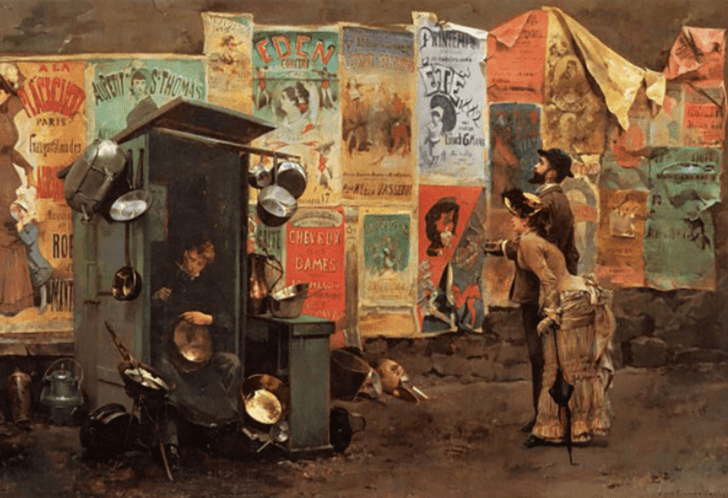
The poster does not have a specific date of invention. From the Egyptians with their hieroglyphic manifestos to the advent of the printing press, all peoples and cities have used their walls, facades, and walls to publicly communicate their messages, but without being able to mechanically reproduce them.
In 1430, Gutenberg invented the printing press, a historic advance for book production, and in 1798, Alois Senefelder invented lithography, initially intended for printing engravings. Seventy years later, the most advanced countries in Europe discovered the usefulness of lithography as a means to advertise products and services through posters. The demand for posters grew and merged with industry and commerce, creating a social phenomenon. By the end of the 19th and early 20th centuries, posters reached their peak.
Considering that a poster is the product of an artistic integration of text and image aimed at publicly communicating a message, the origins of the poster in Spain can be traced back to the 18th century. An example is a bullfighting poster featuring a woodcut vignette and lithographic text to announce a bullfight in Puerto de Santa María in 1782. Another example of a bullfighting poster, Cádiz 1874, shows the introduction of more vignettes, highlighting the importance of imagery in design. The beginnings of lithographic posters in Spain are directly linked to the announcement of traditional festivities. The first colour lithographic posters date back to around 1880, with text predominating over imagery. From 1900 onwards, colourful lithographic images became the protagonists of Spanish posters, covering their surfaces.


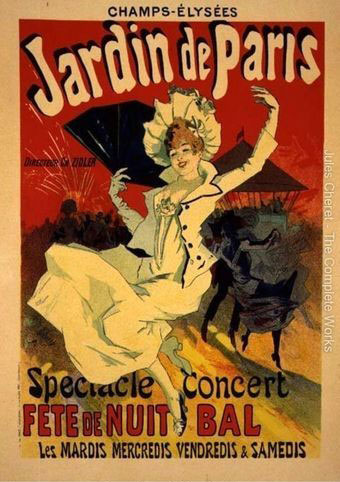
The origins of the poster in Europe focus on 1866, when Jules Chéret (1836-1933) returned to Paris from London. At that time, London was the global centre of industrial expansion. Chéret had worked for seven years as an artist in a lithographic workshop in London, mastering the technique of lithography applied to large sheets of paper. Upon arriving in Paris, he set up his own lithographic workshop, specializing in the production of large posters. Over his 97 years, he designed over a thousand models with his own distinctive style.
Chéret pioneered this new medium of commercial and industrial expression. He flooded Paris with mural posters, painting ethereal female figures suspended in the air, vaporous girls. He used bold, eye-catching colours to capture the attention of passers-by of the time. He literally monopolized the streets and kiosks of Paris. With him, Paris had an art gallery displayed on its streets. He marked an era and a fashion.
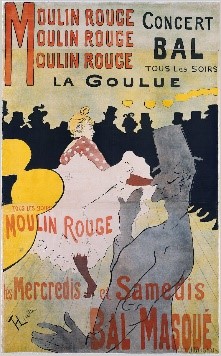
His contemporary, Toulouse-Lautrec (1864-1901), was the great innovator who combined a perfect synthesis of image and text, clearly paving the way for the future. In his short 36-year life span, 400 lithographs are known, 31 of them posters, possibly the most appreciated and valued today. Following these two great innovators, most painters of the time were tempted by the new technique.
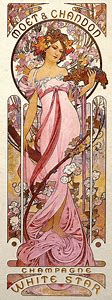
At the end of the 19th and early 20th centuries, Paris saw the development of an artistic movement called Art Nouveau, present in architecture, painting, sculpture, and the decorative arts: furniture, lamps, curtains, jewellery, accessories, clothing… The movement aimed to create a new aesthetic dominated by inspiration from nature. Its leading exponent was the Czech artist Alphonse Mucha. Art Nouveau was characterized by its exquisite and delicate approach to design, with stylized female figures and the use of curved lines.
Mucha’s unmistakable style was imitated by illustrators of the time, including Spanish poster designers such as Alejandro de Riquer, Eulogio Varela, Santiago Rusiñol, and Ramón Casas.
In 1925, the International Exhibition of Modern Decorative and Industrial Arts was held in Paris, giving rise to the artistic term Art Deco. This movement (1920-1939) left its mark on all fields of design: architecture, painting, sculpture, automotive design, interior design, fashion, jewellery… even in cinema, such as Fritz Lang’s film Metropolis. Art Deco represented the opposite of the sinuous and naturalistic curves of Art Nouveau. It was based primarily on simplification, with its rectilinear and geometric style. The spotlight was on athletic and elegant male bodies and assertive women dressed boldly, with bobbed hair, smoking, and participating in cocktails, signifying their liberation. The glamour of the 1930s reached its peak.
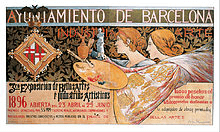
Alejandro de Riquer, 1896

Roberto M. Baldrich, 1930
Spanish artists mastered this style perfectly and applied it flawlessly in creating their posters. Federico Ribas, Rafael Penagos, Gaspar Camps, Enrique Estela Antón, and Juan Miguel Sánchez are some of the artists who epitomized Spanish Art Deco posters.
Subsequently, and up to the present day, the poster has accompanied various avant-garde artistic movements: fauvism, constructivism, cubism, expressionism, surrealism, pop art, minimalism, hyperrealism… The most notable national and international artists have used their brushes to create posters: Pablo Picasso, Salvador Dalí, Joan Miró, Antoni Tàpies, Miquel Barceló, Luis Gordillo, Andy Warhol, David Hockney… among hundreds of celebrated painters.
María Carmen Bernáldez